
Knife Skills for Beginners: The 4 Cuts You Actually Need
Beginner knife skills come down to four cuts: the rough chop, the slice, the dice and the mince. All four sit on the same two grips, pinch the blade, claw the food. Twenty minutes of practice on one onion and two carrots covers the lot. Keep the knife sharp, since dull knives cause most kitchen cuts, not sharp ones.
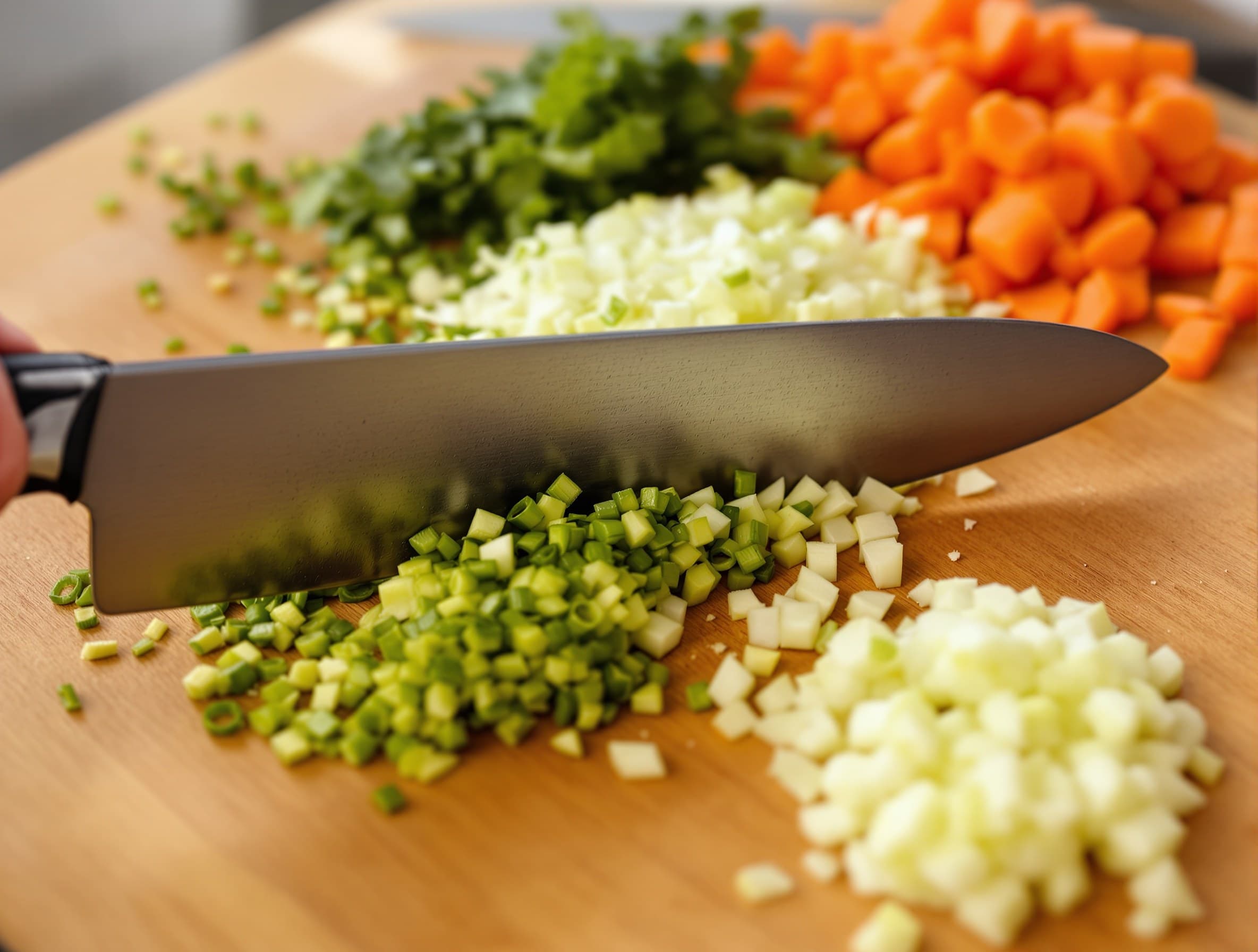
Forget the 15-cut culinary school list. Home cooking runs on four cuts and one grip, and you can learn all of them tonight on one onion and two carrots.
Beginner knife skills are four cuts: the rough chop, the slice, the dice and the mince. Every home recipe you will ever cook asks for one of those four, and all four sit on the same foundation, the claw grip that keeps fingertips folded away from the blade and the pinch grip that keeps the knife under control. Twenty minutes of deliberate practice on an onion and two carrots covers the whole set.
One fact reframes everything: dull knives cause most kitchen cuts, not sharp ones. A dull edge slides off a tomato skin and lands wherever your fingers are; a sharp edge goes where you point it with almost no pressure. Sharpness is a safety feature.
The 2-Minute Setup: Two Grips and a Stable Board
- Pinch grip on the knife: thumb and index finger pinch the blade just in front of the handle, remaining fingers wrap the handle. Wobble disappears immediately.
- Claw grip on the food: fingertips curl under, knuckles forward. The flat of the blade rests lightly against your knuckles as a guide, so the edge physically cannot reach fingertips.
- Anchor the board on a damp folded towel so it cannot slide.
- Rock, do not chop: keep the tip low and roll the blade forward and down through the food.
- Slow is the drill. Speed shows up on its own after a week of cooking, chasing it early is how beginners get hurt.
1. The Rough Chop (Soups, Stews, Roasting)
- Goal: pieces roughly the same size, looks do not matter, even cooking does.
- Halve the vegetable so it sits flat. A flat side on the board is rule one for everything.
- Cut into thick planks, turn, cut across into chunks about 2 to 3 cm.
- Keep the claw, keep the rock, let the sizes be ugly. Rustic is a real culinary word for a reason.
2. The Slice (Stir-Fries, Salads, Toppings)
- Flat side down, always. Halve rounds like cucumber or zucchini first.
- Knuckles forward, blade against them, and pull your claw back a few millimeters between cuts, that spacing IS the slice thickness.
- For thin, even slices, slow down and let the blade do a full rocking stroke per cut.
- Angle the blade 45 degrees for wider oval slices of thin things like spring onions and carrots.
3. The Dice, aka the Onion (Almost Every Savory Dish)
- Halve the onion pole to pole, peel, lay flat. Leave the root end on, it holds the layers together.
- Make horizontal cuts toward the root, stopping 1 cm before it, then vertical cuts the same way.
- Now slice across: perfect dice falls off the knife, the root nub goes to compost.
- Same grid logic dices carrots, peppers and potatoes: planks, then sticks, then cubes.
- Aim for 1 cm dice as default, half that when a recipe says fine dice.
4. The Mince (Garlic, Ginger, Herbs, Chili)
- Smash the garlic clove with the flat of the blade, palm pressed on the steel, never the edge. The peel falls off.
- Rough-chop it small first.
- Then the two-hand rock: fingertips of the free hand rest flat on the spine near the tip, and the knife rocks side to side over the pile like a see-saw.
- Gather the pile with the SPINE of the blade, not the edge, and rock again until it is as fine as the recipe wants.
- Herbs mince the same way: roll leafy herbs into a tight cigar first, slice thin, then rock.
Do I need an expensive knife to learn?
No. A 30 to 50 franc chef's knife with a 20 cm blade is more than any home cook needs, provided it is kept sharp. Hone it weekly on a rod at roughly 15 degrees per side and get it properly sharpened about twice a year. Technique on a cheap sharp knife beats a premium knife used dull, every single time.
How long until knife work feels natural?
About two weeks of normal dinner cooking. The claw feels awkward for the first three onions and then becomes permanent muscle memory. Practice deliberately once: buy two carrots and one onion, run all four cuts in one 20-minute session, and every dinner afterwards is free practice. The rest of the foundation lives in the cooking skills everyone should know, and your freshly diced onions have a destiny waiting in how to caramelize onions.
Tell Pann the one ingredient you have and it builds a meal around it, sized to your goal, then walks you through every cut and every step.
Frequently asked questions
What knife cuts do beginners actually need?
Four. The rough chop for soups, stews and roasting, the slice for stir-fries, salads and toppings, the dice for almost every savoury dish, and the mince for garlic, ginger, herbs and chilli. Every home recipe asks for one of those four.
How do you hold a chef's knife properly?
Use the pinch grip. Thumb and index finger pinch the blade just in front of the handle, the remaining fingers wrap the handle. The wobble disappears immediately. Your other hand uses the claw grip, fingertips curled under, knuckles forward against the flat of the blade.
How do you dice an onion?
Halve it pole to pole, peel, lay it flat and leave the root end on so the layers hold together. Make horizontal cuts toward the root, stopping about 1 cm short, then vertical cuts the same way, then slice across. Aim for 1 cm dice.
Do I need an expensive knife to learn knife skills?
No. A 30 to 50 franc chef's knife with a 20 cm blade is more than any home cook needs, as long as you keep it sharp. Hone it weekly on a rod at roughly 15 degrees per side and get it properly sharpened about twice a year.
Why are dull knives more dangerous than sharp ones?
A dull edge slides off something like a tomato skin and lands wherever your fingers are. A sharp edge goes where you point it with almost no pressure. That is why dull knives cause most kitchen cuts. Sharpness is a safety feature, not a luxury.
How long does it take before knife work feels natural?
About two weeks of normal dinner cooking. The claw grip feels awkward for the first three onions and then becomes muscle memory. Practise deliberately once, run all four cuts in a 20-minute session, and every dinner after that is free practice.